Espanol & English Activities for ¿De Dónde Eres? read aloud

Click the Button Below ESPANOL_ACTIVITIES FOR ¿DE DÓNDE ERES? READ ALOUD. ENGLISH_ACTIVITIES FOR ¿DE DÓNDE ERES? READ ALOUD.
Vocabulary Journal – Building Academic Vocabulary With Speed – Day 1

Click the Button Below VOCABULARY JOURNAL – BUILDING ACADEMIC VOCABULARY WITH SPEED
Learning From Home During COVID-19
Click the Button Below LEARNING FROM HOME DURING COVID-19
NABE 2020
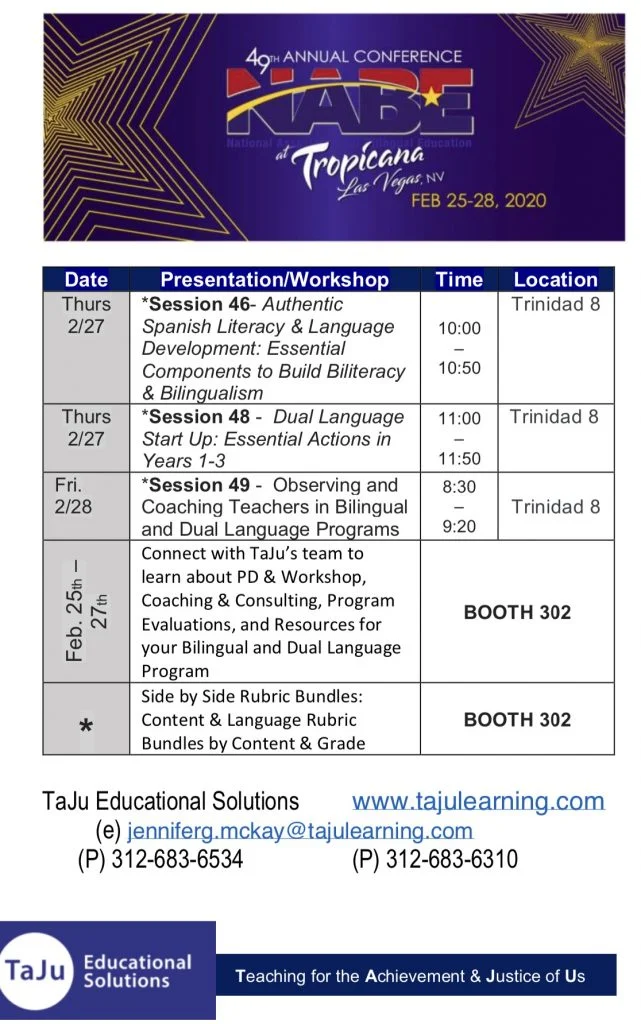
Coaching Teachers in Bilingual and Dual Language Classrooms
Gain the skills you need to coach teachers in bilingual and dual-language classrooms. In this practical guide, you will discover a proven process for creating a fair and effective observation and feedback cycle to help support bilingual teachers in this important work. Author Alexandra Guilamo offers pertinent coaching theory and accessible coaching strategies sourced directly from her firsthand experiences in dual-language education. Use this bilingual education book to guide your instructional coaching: Explore the dual-language programs currently used in classrooms and schools and their unique qualities and benefits. Learn the seven essential elements of an effective coaching and feedback cycle. Gain best practices you can utilize in your work as a coach and observer of dual-language teachers. Study the characteristics of high-quality feedback. Receive answers to frequently asked questions on dual-language instruction. Click here to order
Please Don’t Let This “News” Pass, Our Children’s Lives Depend on It
I woke up this morning to the barrage of media covering yet another unimaginable mass shooting. The families and extended communities of 17 high school children must now grapple with the loss of the lives that were and the lives that would have been. As I sit here writing this post with tears in my eyes, I am struggling with the overwhelming need to will away the inner voice that is asking, “What if it had been my student? What if it had been my child?”
Week of June 19th Online PD
These two online workshops are “game changers” for schools that are ready to focus on accelerating ELLs language development and ability to tackle the CCSS!
Long-lasting Connections: An Essential Ingredient in Dual Language Programs
I have had a lot of questions recently about dual language support and dual language programs? What is the difference between a bilingual program and a dual language program? Can I just change the name? Well, in truth, that’s one option, but it does not truly get at the “jist” of what makes each program model unique and it might not be the most effective way to make lasting and meaningful change for students and the teachers who serve them? So what is the difference between the two? In short, it comes down to what each program believes is best for students to develop their language skills and their content mastery. In short, here is a very simplified breakdown: One of the most important and noticeable differences is the function language plays and how each language is intentionally used to strengthen the other. So what does that mean? In most dual language programs, the use of the non-English language, let’s say Spanish, continues even after students have continued beyond 4th grade and have been deemed proficient in English. The “point” then is not necessarily to acquire English at the expense of the other language at their disposal, rather to continue to add to how effectively they can use both Spanish and English. This “additive model” allows students to be more intentional linguists, more aware consumers of information, and more effective global citizens. Students are able to use use each language to strengthen the other through intentional work on the part of the teacher and students. Through bridging (Beeman, 2013), students are able to make powerful connections from what the know about one language in order to bring it over to the other. It involves a number of moves designed to allow students time to study what is happening in the language being used, before applying that learning over to the other language. Students, then, are asked to look at, study, and analyze what is similar and what is different in how words sound (e.g. doctor and doctor), what they look like (e.g. bicycle and bicicleta), how we order words in a sentence (e.g. the car blue or the blue car) or syntax, and other grammatical features that help students to understand the rules of the language. This time in the Bridge is critical time for students to make connections that allow them to not just understand the content standard but the language that they need to communicate what it is that they know. These connections, in fact, are one of the most important ingredients in dual language programs, particularly in a common core world. Do students have time to take what they’ve learned in order to connect it to the other language? Or will they need to relearn the entire lesson once they’ve switched from Spanish to English? If this need to relearn everything exists, how will they ever catch up to their monolingual peers? The connections we make in the bridge allow students to be aware of the language, the rules, and all the other ingredients in their language system in order to use this information when they need it the most. This awareness is what is needed for students to develop strong and critical literacy and language skills that increase outcomes for all students. So when I am asked what is the biggest difference between monolingual, TBE and dual language programs are? I tell them, don’t forget to add those long-term connections to the mix. Reference: Beeman, K. & Urow, C. (2013). Teaching for Biliteracy: Strengthening Bridges between Languages. Philadelphia: Caslon Publishing.
What level of cultural proficiency is your school and how do you know?
Throughout the years, I’ve had the opportunity to visit many schools, and even more classrooms. I’ve seen some pretty amazing teaching, and opportunities to continue refining the work. In most cases, I’ve been able to see a direct link between the culture and climate in the school and the performance of the students. Now more than ever, I think it is critical that we consider the impact of our views and actions as it relates to culture, not just because it is the right thing to do, but because our students need us to. The majority of schools with whom I work are highly diverse. However, a few weeks ago, I found myself visiting with a particular school that had a very high latino population. I walked into the office to Spanish and English flowing seamlessly as a delightful office clerk answers the phone, buzzes people into the main office, and asks me with a smile to hold on just a moment. As I wait for her to finish the phone call, I look around. There are signs in English and Spanish, paperwork and notices in both languages and even books for students to read as they were waiting in both languages, as well. I was impressed. It is not often that both languages (Spanish and English) are honored, valued, and seen as an asset that can be used to create bridges between homes, schools, and the community, but this seemed different. I walked through the halls heading to my first classroom visit with anticipation. And my knowledge of the teachers, their work ethic, their passion for students, and their thoughtfulness, only served to egg on that very excitement. We spent the day working with students, thinking about their literacy levels, discussing ways that their language acquisition stage impacts their reading successes and challenges, and action planned what to do about it. It was, for all intents and purposes, a great day. However, I walked away from that day saddened. No, it was not because of the conversations or the work. It was not the stage of implementation the teachers had achieved. It was not a lack of reflection, which can be frustrating, but was not the case. It had little to do with the best practices and strategies that were being employed. Rather, it was the culture and tone of the students in the building that I had been so moved by at the beginning of the day. Students were angry. They were bitter. They were indignant and looking to challenge or dare anyone who wanted to reach them. I asked the teachers how long this had been going on. After all, I had been at the school not even two months prior, and the pulse of the building had not been the same. What had changed? In the month prior to my arrival, the country’s new administration began making drastic changes as it relates to both their immigration policies and their policy (explicitly or implicitly) around what “business as usual” will now mean. As a result of these two shifts, our students are getting the message from this administration that, “we want you out” and “we will communicate our disdain of you however we want and whenever we want”. As many of Illinois largest school districts work to address these drastic and continually changing immigration policies and attitudes, a number of districts have begun to explicitly communicate to their building leaders that they are not to let federal immigration authorities inside district buildings without a criminal warrant. In addition, district and state leaders are urging schools to obtain “alternate emergency contacts” for students in case their parents are detained by immigration authorities while they are in school. While these steps are necessary, it does little to serve the outraged youth that are caught between a rock and a hard place. So what can schools do to begin to mediate some of the impact? First, we need to reflect on our level of cultural proficiency, not just in individual classrooms, but as a school and as an extension of our communities. Do we collectively have the skills, habits, and ability to to allow students’ culture to be an asset and a gift during the instructional process and do we have the awareness of when we must allow culture to sit in the driver seat for just a bit, while still attending to the standards? In order to reflect, Baron (2007) defines the following levels of cultural proficiency: Culturally destructive individuals or systems are those who engage in practices and support those practices or behaviors that eliminate the marks, signs, or confirmations of other people’s culture. Guiding Question: Is there a sentiment in the building that all the hugging, speaking in “another language”, and singing all the time, reflect problematic behaviors that need to be stopped? Cultural Incapacity individuals or systems are those who believe that another way of doing things is better, it usually stems from a lack of awareness and/or skill, but still has the impact of perpetuating stereotypes of non-dominant groups. Guiding Question: Is there a sentiment in the building that “these” students are just lazy and there’s no point in sending home notices, because their parents don’t know how to read anyway? Cultural Blindness individuals or systems are those who believe that everyone is the same. Guiding Question: Is there a sentiment in the building or with an individual that “I don’t see race as an issue, you are a person just like me. Therefore if you bring it up, it is your problem, not mine?” Cultural Pre-Competence individuals or systems are those who recognize that race, culture and language do make a difference but they are not willing to change. Guiding Question: Is there a tendency to hear damaging language or comments about students or their families in the building and recognize them as completely wrong, but individuals don’t do anything to change the behavior. “Who am I to address them?” Competence individuals or systems are those who accept, appreciates, and sees the value added by seeing opinions and insights of diverse groups and individuals. Guiding Question: Is there a tendency to seek out literature and advice
3 Critical Cultural Issues of Reaching Students:

I stared at my boss with blank eyes as she repeated her question. “How culturally aware are you?” Back then, I was still a principal, and the question had come up in a conversation about hiring, supporting and retaining high quality teachers. I blinked, wondering how this could even be a question. I clearly was a minority, I had lived in another country, my first language is not English, I had experienced racism in the U.S. Wasn’t I the poster child of cultural awareness? “You have a school with 99% minorities; do you want to be successful?” In the moment, I found myself beginning to get defensive; had I not SEEN my students, who they were, what they brought to the table? Thinking back on that experience, I now realize just how culturally out of tune I was. I was so focused on what I was doing and my own cultural experience, that I didn’t think of why that question might even be important for me to explore – this issue of how cultural differences (regardless of which cultures are represented) can impact people’s experiences in and around education. How every individual that is part of a school community has an attitude and a manner of behaving that is, in part, shaped by our culturally context and cultural identity. And yes, this includes me. In recent years, I have begun to explore more in depth what cultural awareness means and how I can be more culturally aware in order to better understand my students and teachers with whom I work. After all, if I can’t understand the people I serve, how can I possibly reach them? In exploring this topic, I’ve come to the following conclusion: while culture is quite complex, there are three critical things, particularly for immigrant teens, that we must learn quickly and begin to address if we want to make a difference in a student’s life: We must learn about their culture. What do you know about the cultural richness and assets of the students in your class beyond stereotypes? What do students value? How do students define their culture? What is important to them and what is their educational experience? Students who are used to having an adult-driven, seated in rows educational experience might have a hard time adjusting to a collaborative project that involves students debating each others point of views because it goes against a cultural norm that has long been established. We learn how to involve their parents and community allies What expectations do parents have of teachers and schools? Are teachers and schools on the same page around the role of parents in the education of their child? Are there additional resource in the community that your families trust? We must learn and appreciate how culture impacts learning What prior knowledge do students have? What are priorities for your students and how will that impact learning and the way students resolve conflicts in the classroom? How will your students learn best? By answering these questions, you can begin to learn more about the students that you serve as well. In the end, every person brings a set of experiences that serves as a lense through which we see the world. This is not a bad thing, but one that makes it more critical that we as teachers make our first job that of being lifelong learners. That is the true key to success.